Have a piece of candy, and then take another one
The Korean adaptation of Animal Farm by the students of the Korean National University of Arts offers a visually captivating, yet conceptually simplified interpretation of Orwell’s famous allegory. Taein Kwak’s production relies on repetition, stylized acting, and a sensory audience experience, shifting the focus away from the political layer toward aesthetics and atmosphere. The result is an appealing, almost fairy-tale-like world, beneath whose surface lies an unsettling image of a willingly accepted dictatorship.
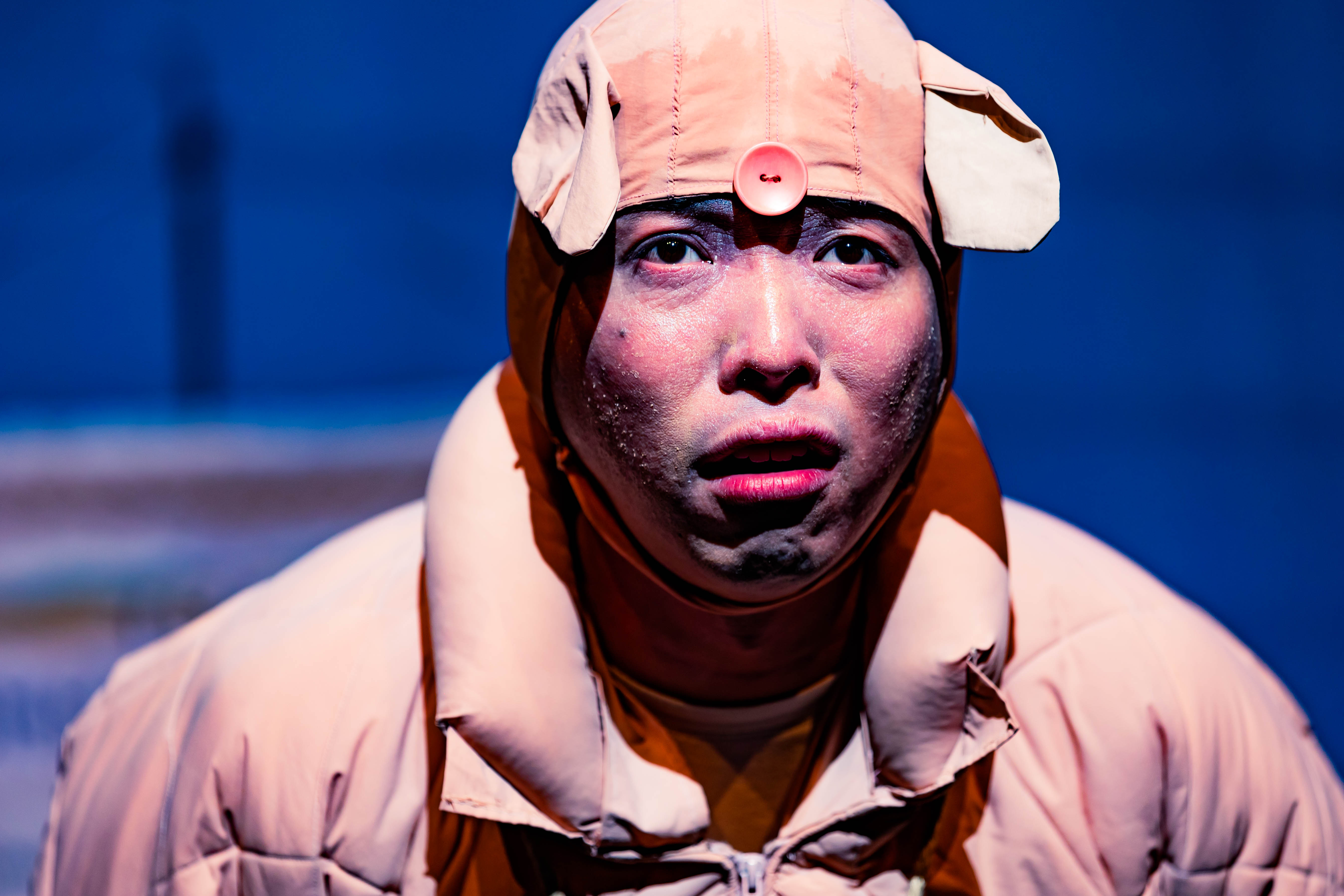
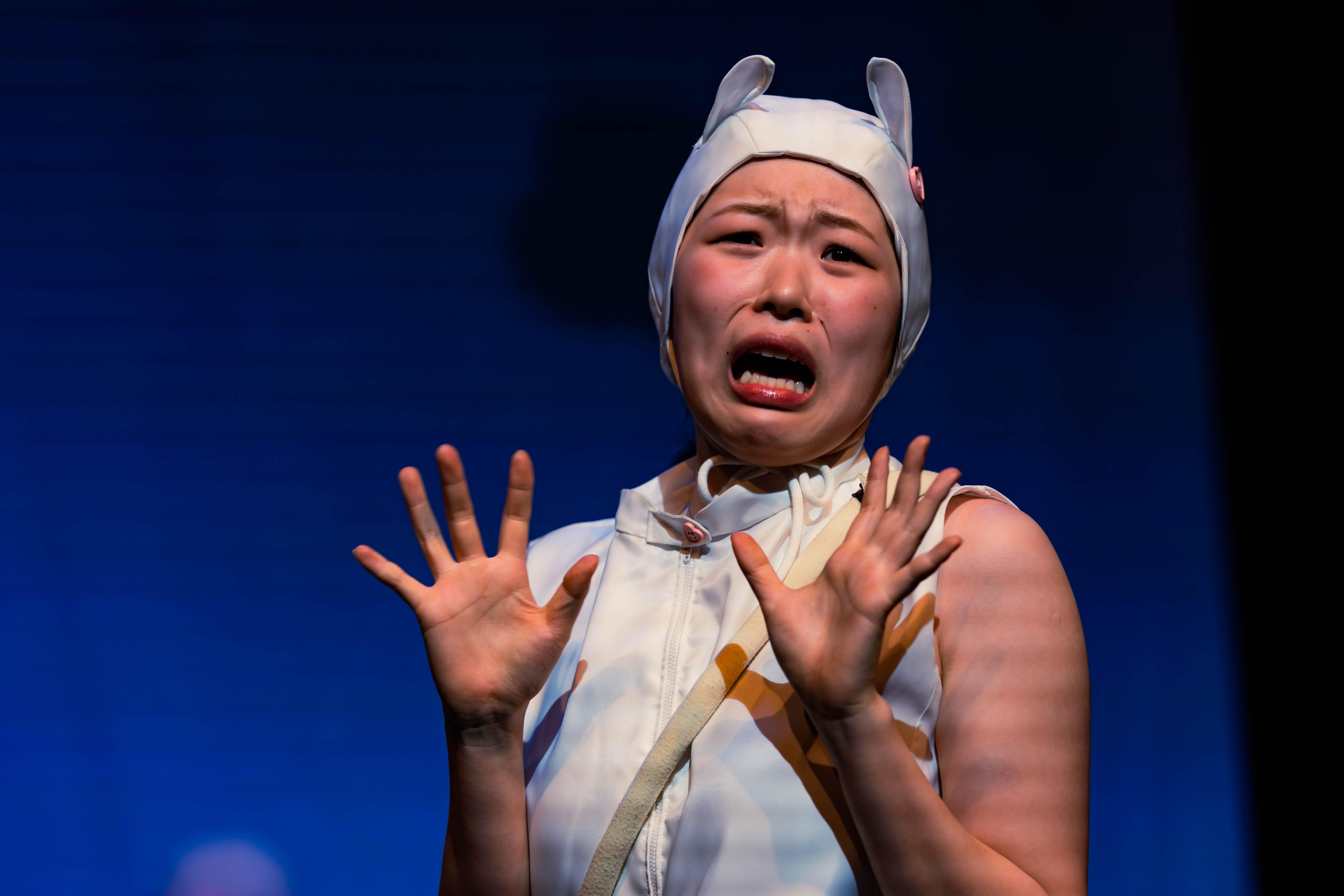
Animal Farm, as staged by the students of the Korean National University of Arts (School of Drama),appears as if it has landed on the stage from another universe. The production is based on George Orwell’s novella Animal Farm, which itself carries a relatively easy-to-decode allegory of a communist regime. In Taein Kwak’s adaptation, the basic framework of this metaphor remains, but it is further simplified, made repetitive, and delivered multiple times, allowing the audience to focus less on understanding the message and more on immersing themselves in the audiovisual experience. A large white sheet hangs on stage (concealing its depth), while in front of it stands a wooden fence and several paper houses. The performance style is highly stylized and vibrant. The actors are always presented in their most refined form. Their expressions are exaggerated, vocal, and at times perhaps even infantilized, yet they correspond with the overall concept of the production, which resembles a children’s fairy tale.
The costumes do not strongly evoke animals, but rather follow japandi-style trends, featuring soft earthy tones, with the animal identity recognisable mainly through headpieces with ears. This aesthetic aligns with the overall cuteness and sweetness. Photographs from previous performances reveal that the original scenography resembled a colourful Teletubbies-like world: idyllic at first glance, with everyone appearing flawless, but what lies beneath the surface? From this childlike fairy tale emerges the dictatorial regime of the pig Napoleon. Meanwhile, the other animals deal with superficial concerns such as longing for beauty, ensuring their social media videos are shot from the right angles, counting followers, and so on.
Kwak omits a great deal from Orwell’s original novella. The famous motto of the novella “All animals are equal, but some animals are more equal than others”, is entirely absent. Napoleon declares himself a dictator from the very beginning, without needing to rise to power through the manipulation described by Orwell. In Kwak’s version, all the animals accept the self-proclaimed dictator from the outset.
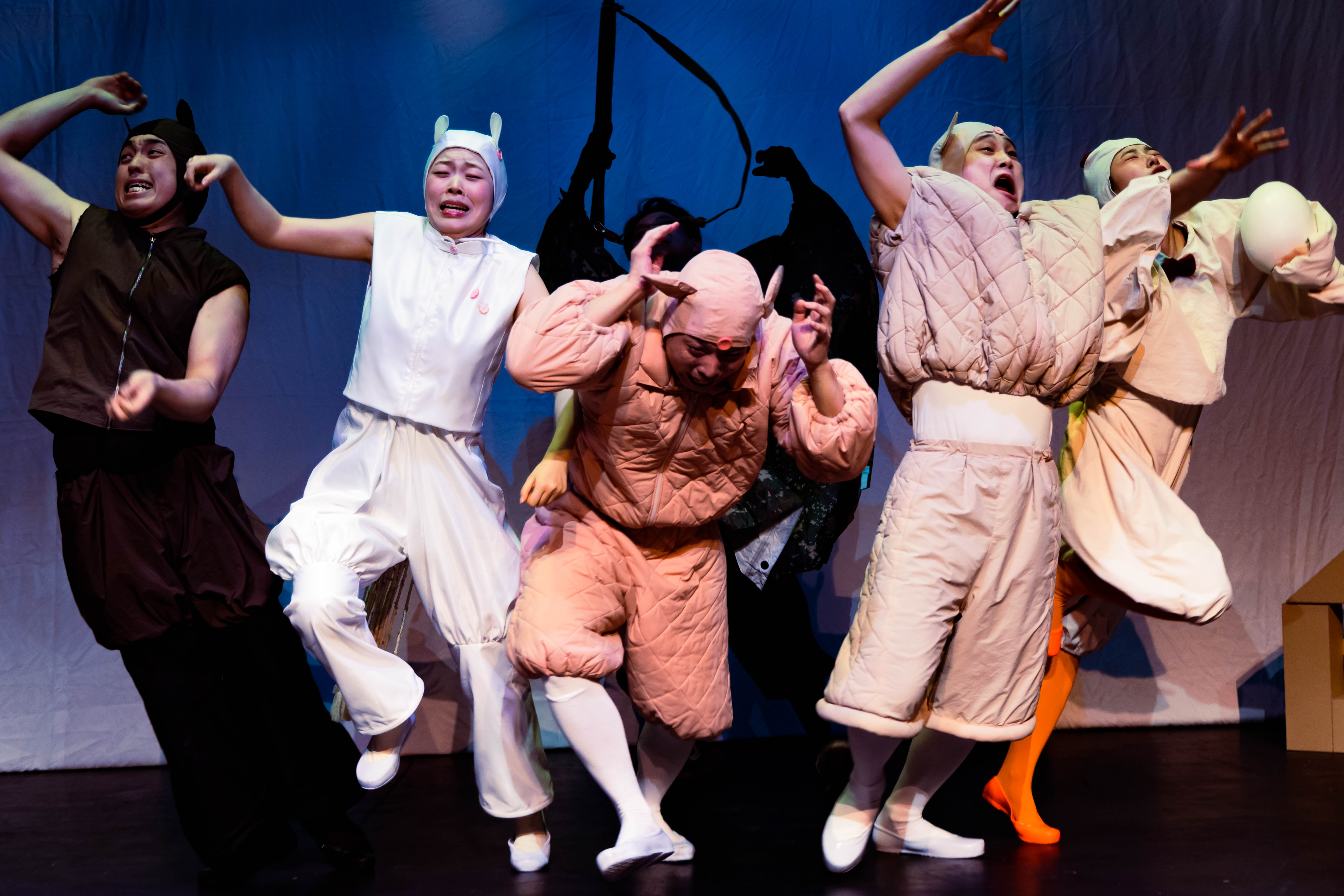
At the beginning, we see the animals seated in a classroom. Their teacher, a raven who also serves as the main narrator, gives them candy that puts them to sleep, and the entire story then unfolds as a dream from which they eventually awaken. Yet no self-reflection follows, as they immediately consume the same candy again. The desire for Sugar Candy Mountain outweighs the trauma of collective memory and suppresses any warning dreams. The circle closes, the spiral opens, and the cycle can begin again.
Upon entering the auditorium, each audience member finds a piece of candy wrapped in shiny cellophane at their seat—the same candy eaten by the animals on stage. The spectator thus becomes part of the performance. This synesthetic experience, which blurs the boundaries between audience and performers, adds an intriguing layer. It recalls the Brno-based ensemble Quidam, founded in the 1960s around the artist J. Pavloušek; during their production of the Last Battle of King Sardanapalus, spectators could smear white paint onto the actors and become part of the process.
Engaging not only sight and hearing but also touch—and even less “noble” senses such as taste—deepens the experience. In Animal Farm, the candy allows each spectator to become one of the animals lured into the trap. Anyone who tastes the sweet in its cute wrapping becomes intoxicated by sugar, turning into a passive flock submitting to the dictator. Everyone has at some point been warned not to take candy from strangers, yet we are guilty, we are part of the problem.
During the performance, more than one spectator laughed, and as Antonin Artaud suggests, laughter is the most anarchistic force we possess. Thus, the one who laughs becomes an opponent of Napoleon’s propaganda—revealing humour within the oppressive theme and stepping outside the imposed framework.
The author: Veronika Vaňková
The photographer: Jasmína Georgieová