Irenka: A Century in Five Minutes
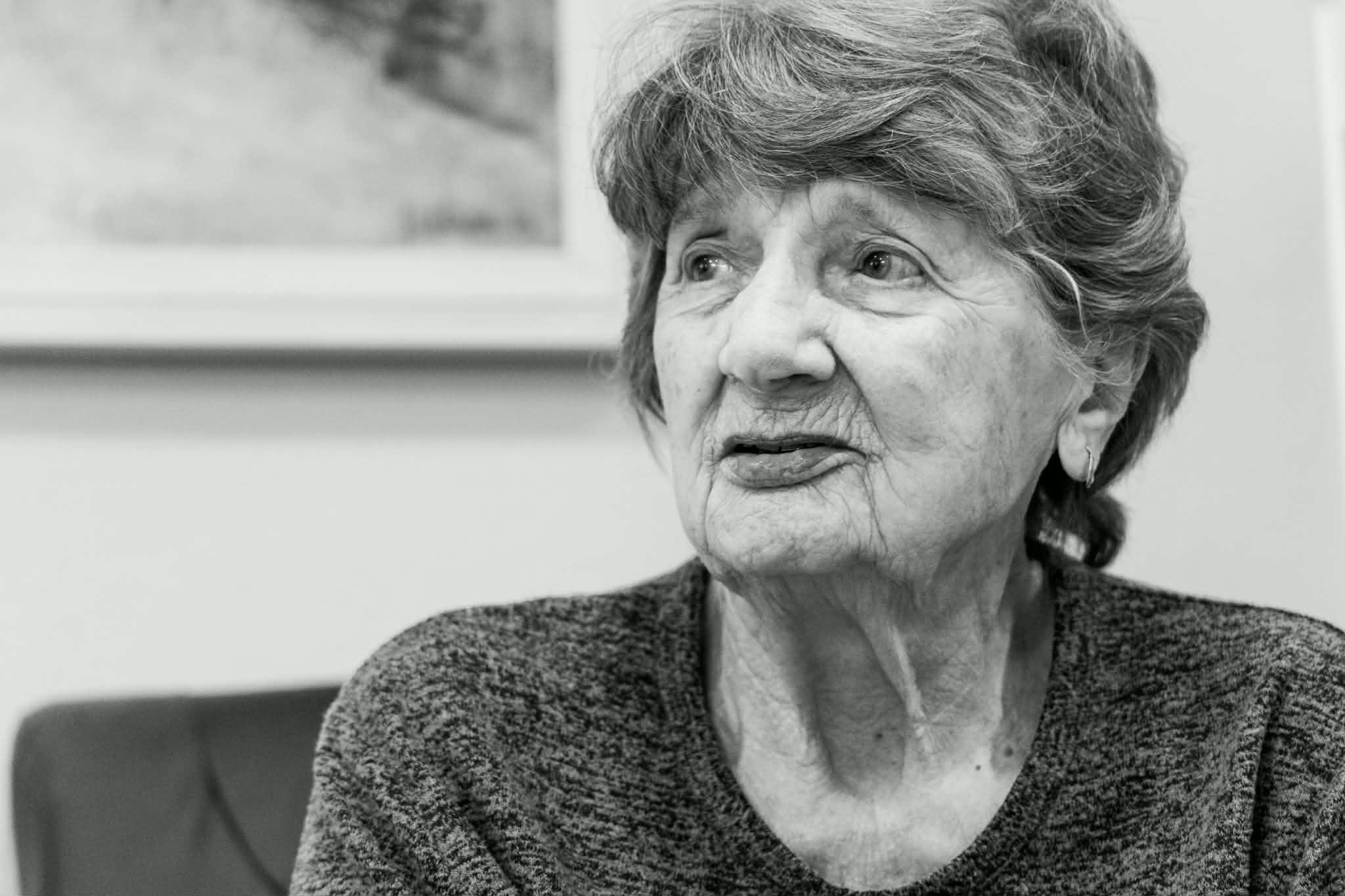
At the international theatre festival Encounter, visitors had the opportunity to see work by students from our department of audiovisual arts. The first film screened in the series was Irenka, an almost five-minute-long photo film about the filmmaker’s great-grandmother. Through a series of brief episodes, it recounts the story of her father, who fought in the First World War, her own life during the Protectorate and the years that followed, as well as her reflections on and anxieties about the world to come. The photographs capture a small, meticulously kept flat, with its carefully organised bookcase, antique glassware, and crossword puzzles – her great passion. Their conversations are mediated through a tablet, which serves as a bridge between the filmmaker and her great-grandmother, whose hearing has significantly deteriorated.
Barbora Kučerová studies Audiovisual Arts and Theatre at JAMU, where she is currently in the third year of her bachelor’s degree. In her work, she enjoys combining different audiovisual forms, particularly photography and film. She feels especially close to the documentary style.
What inspired you to portray your great-grandmother’s life?
At school, we were assigned an exercise to make a photographic film about a person. And when you have a great-grandmother who is a hundred years old, everything naturally leads back to her. I have actually been trying to capture her life in different ways for quite some time. She herself writes a great deal – memoirs, life accounts, records of everything she has lived through. But I still feel that her life is so remarkable that it deserves far more attention. So, whenever I get the chance to preserve something of her and hold on to it, I take it.
What did your creative process look like?
I spent a weekend with her, just the two of us. Before that, though, I had already spent two days at her place with only my camera, photographing everything that struck me as emblematic of her life. She lives in a tiny flat, and everything in it is incredibly modest and tidy; some objects are almost draped in cobwebs because they have been sitting there untouched for twenty years.
Then I started asking her questions. In a way, I approached it as an extension of the conversations we usually have through the tablet. As is often the case with older people, she repeated herself quite a lot, so I already had a fairly good sense of the answers I was likely to get and mainly tried to guide her towards them. She often tended to say, “Well, as I was telling you…” and I had to gently steer her and explain what it was I was asking for.
At first, she was quite nervous around the technology, because not long ago, at the age of one hundred, her ID card expired and she had to go through the whole process of renewing it. Someone from the local authority came to photograph her for that purpose. So when I then turned up with a camera of my own, she was far from enthusiastic.
Some of your great-grandmother’s lines are repeated in the film. Is that because older people tend to repeat themselves when telling stories?
Before I answer that, I should return briefly to the process itself. I spoke with her continuously for roughly two hours. From that conversation, I wanted to select the most essential moments, those that could convey all five phases of her long life. She would often say things like, “Well, during the war…” I placed these lines at the beginning, and then in each individual episode I explained what lay behind them.
I also used repetition deliberately because every time we leave, she says, “Perhaps we won’t see each other again.” It is something she has been saying for the past twenty years.
How did you choose the photographs?
I tried to use them to create an arc: first, a sense of the person’s space, and then of the person herself. At the same time, I did not want her to appear too often in an explicit way. What interested me more was how she is shaped by the environment around her. Her living space feels like a stark contrast to everything she has lived through over the course of her life. It is simply a modest little room.
What was it like working with your great-grandmother? Did she find it difficult to share these things?
Not at all. We are very close, so it felt completely natural. After a while, I had the impression that she had more or less forgotten I was even standing there with a camera or microphone. So the collaboration was wonderful. I work with her quite often, so in a sense she is already used to it. What was amusing, though, was that when I was leaving after the recording, she told me to show her the finished piece soon, as if it were not at least a week’s work.
What have you already made about her?
For example, I made a short documentary about sex, in which she talks about how humiliating she finds it to switch on the television and see relationships and sexuality everywhere. Her daughter (my grandmother) then joined in, and so did my mother. Through those three generations, each of them shared her own distinct point of view.
When she was telling you her story, what emotions did she show? Had she grown detached from it over time, or was she reliving it emotionally?
I think it was a combination of both. When she talks about the war and I ask her about the details, I can see her eyes glaze over. It is not the kind of emotional bond to one’s life that can simply be cut away or erased. At the same time, she is probably the most reconciled person I know, because I do not think anyone could endure a hundred years otherwise.
How should we talk to older people?
It depends on the individual. What matters is tuning in, empathetically, to what that person needs. Everyone creates their own world, and I think it is important not to tear that world apart, but rather to try to understand it. If you say to a hundred-year-old person, “No, that’s not how it was,” then who is really right – the person who has been here for a century, or the person who thinks they know everything? What matters is simply being there.
What values has this given you?
Personally, I approached it as an attempt to get to know her even better and to pass on her experience. This particular piece did not in itself pass any values to me, but it certainly brought me closer to my great-grandmother, because every meeting with her teaches me values. Values regarding life in general, the conflicts unfolding today, and freedom – the very freedom she herself did not experience. And about how to appreciate the moment we are given, as well, and even ageing itself. During the Second World War, she lost her adolescence, and you can still feel that sense of something having been taken from her. It makes you realise all the more just how important it is to value the time we have.
author: Eva Nývltová
Photo: Barbora Kučerová