Medea Runs Wild in Brno, Wearing an Old Woman’s Mask
This production by the Latvian Academy of Culture offers the festival a distinctive take on the poetics of commedia dell’arte, where traditional character types, masks, and physical acting meet ironic distance and contemporary elements. This grotesque family story, oscillating between comedy and tragedy, demonstrates how a historical form can be approached freely without striving for reconstruction, but with respect for its core principles.
The Latvian Academy of Culture from Riga brought to the festival a production entitled The Dreamers, which clearly builds on the tradition of commedia dell’arte, both in its typology of characters and in its strongly stylized acting. On stage, the performers move in and out of a designatedacting area; whenever they leave, they remove their masks and step out of character, effectively becoming spectators. This creates a metatheatrical effect and highlights the boundary between fiction and reality.
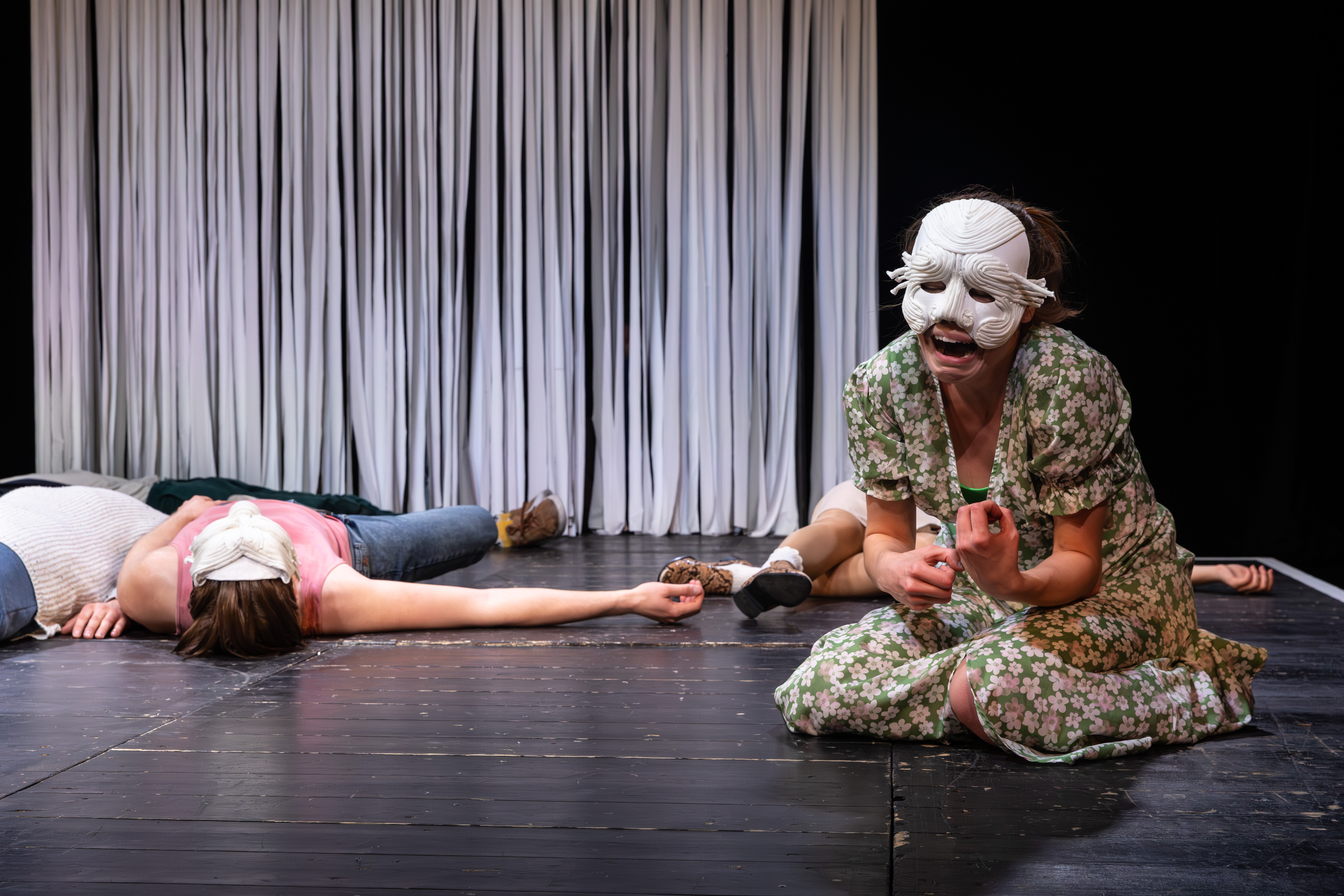
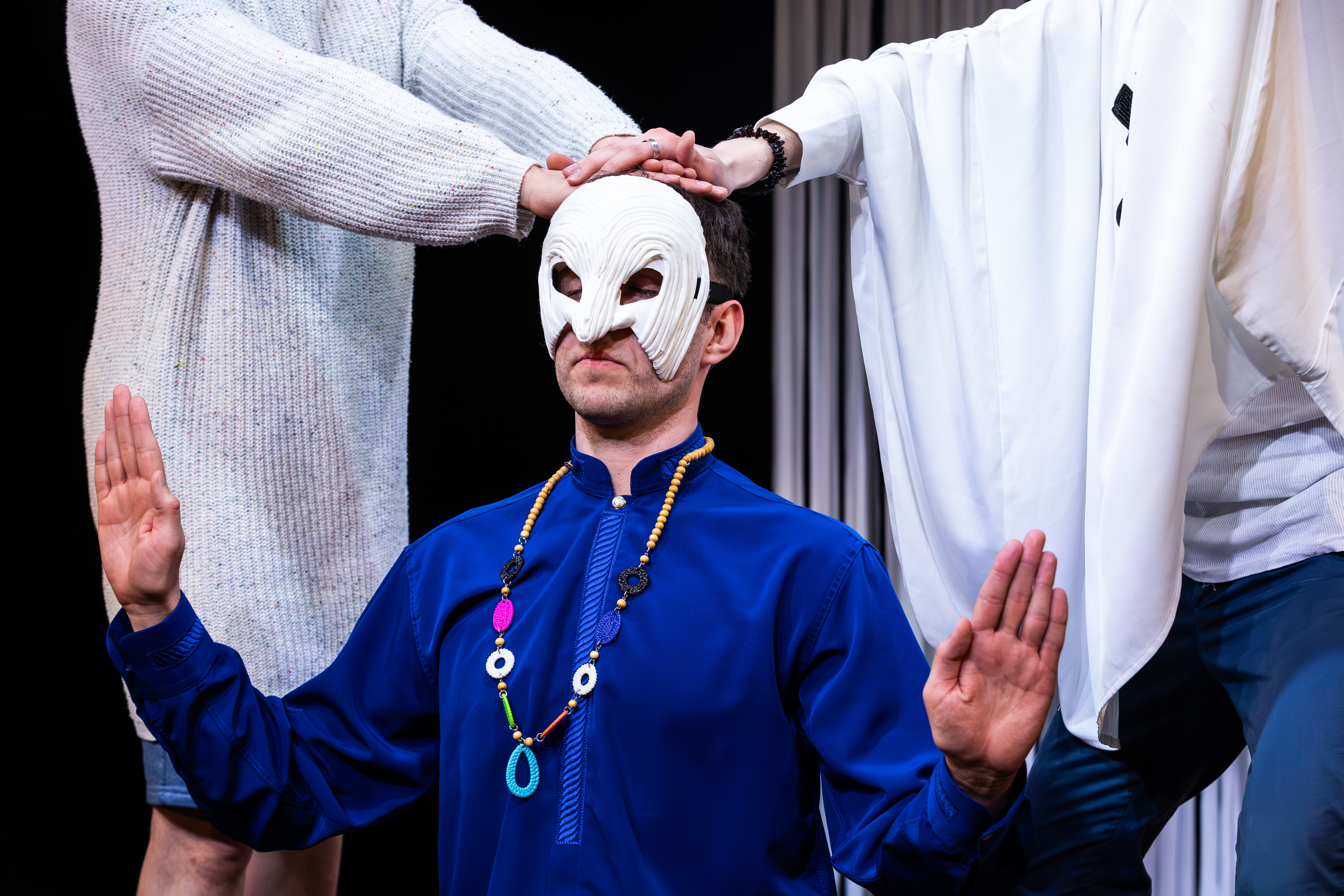
The masks used are entirely white, covering the upper part of the face, and their most striking feature is their texture. The material resembles rope, which shapes the facial features into deep wrinkles, furrowed brows, and pronounced reliefs recalling the expressive masks of traditional commedia dell’arte. Yet the masks are not strongly differentiated; placed side by side, it would be difficult to tell which belongs to which character. Attached with elastic, they cover only the front of the face, so when an actor turns sideways, a sharp, almost jarring transition appears between the mask and the bare face. As a result, the masks function primarily from a frontal perspective, emphasizing both their stylization and a certain “imperfection” as a theatrical sign.
The performance follows the story of the Berzins family. The mother, Inga, owns a bakery and raises three sons after divorcing her husband. The plot includes a motif reminiscent of a Lear-like trial: the mother asks her sons to bake a pie to prove who is most capable of taking over the family business. One of the sons refuses to let her taste his pie and is cast out of the house. He sets off in search of his father and meets a homeless man who becomes his guide, a figure strongly resembling Harlequin: cunning, servile, and driven by an insatiable hunger for pies.
As the plot unfolds, it culminates in a grotesquely tragic moment in which the mother, in a fit of rage, kills all her children and the other characters present, declaring herself Medea. She even begins to recite the tragedy, only to interrupt herself by admitting she has forgotten some lines, before taking her own life. This tragic climax is immediately undercut: all the characters rise from the dead, resolve their conflicts, and the performance ends happily, in keeping with comic tradition.
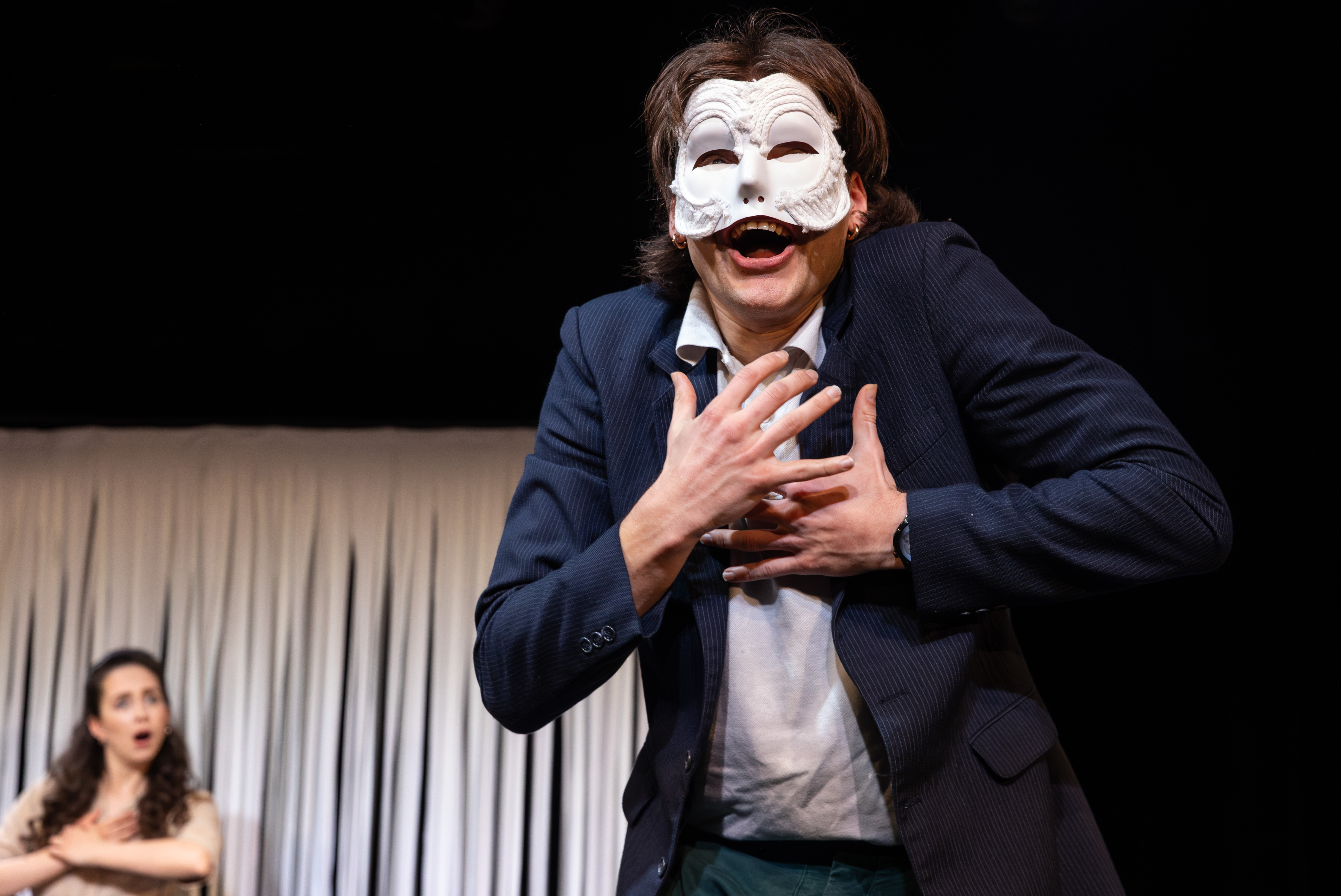
The acting is based heavily on physical stylisation, working with the body and gesture, drawing on the principles of commedia dell’arte. The characters can be readily aligned with traditional types: the mother Inga represents the vecchia category, an old figure of authority, a kind of female Pantalone, embodying the old order, stingy and power-driven, obstructing her children’s romantic relationships. Her ex-husband, portrayed as an esoteric guru and fortune teller, corresponds to Il Dottore. The two older sons are innamorati, lovers competing for the affection of a woman; their conflict is resolved through the comic revelation that she has an identical twin. The third key group, the zanni (astute servants), is represented by Druzina’s servant as well as a homeless man, both bearing traits of the traditional comic servant.
An intriguing detail is that two characters—the youngest son and the young woman—remain unmasked throughout. This choice invites multiple interpretations. The youngest son’s lack of a mask could signal his disruption of the established order, as he refuses his mother’s authority, though this explanation feels insufficient. A more compelling reading lies in the metatheatrical dimension: the production may allude to the historical development of commedia dell’arte, during which masks were gradually abandoned. The Latvian staging suggests a transitional phase, where some characters still wear masks while others have already discarded them—symbolically pointing toward a future in which the mask as a theatrical sign disappears altogether.
The Latvian ensemble does not offer a direct developmental line of commedia dell’arte, nor does it attempt to. Rather, it carries its poetics, grotesqueness, and a certain stylized elegance into its own theatrical language. One might regret the absence of improvisation based on an open-ended scenario, a hallmark of the tradition. However, this choice is entirely understandable: within the context of an international festival, improvisation would encounter a difficult-to-overcome language barrier. Even so, the production offers a valuable encounter with living inspiration drawn from the tradition of commedia dell’arte.
Author: Veronika Vaňková
Photo: Linda Dobrovolná