Raspberry, My Sister and a Loaf of Bread, My Lover
Blurring the lines between grotesque, musical, and a return to the very essence of theater, the Polish delegation presents a radically condensed version of Balladyna, only an echo of Juliusz Słowacki’s five-act drama. Directed by Lada Borovska and featuring Agnieszka Solská’s solo performance, a tragic story of guilt and power becomes a disturbingly playful yet cruel spectacle, where a single actress creates an entire world.
The Białystok branch of the Aleksander Zelwerowicz Academy of Dramatic Art presented a production inspired by Juliusz Słowacki’s drama Balladyna. Rather than staging the original text, it draws on a late-1960s adaptation by Polish poet, singer, and cabaret artist Jeremi Przybora, best known for Kabaret Starszych Panów.
In Słowacki’s original, Balladyna murders her sister Alina to eliminate her rival for the love of the knight Kirkor. She continues committing crimes along her climb to the top, only to be struck down by lightning at the height of her power. Przybora’s version strips the play down to its bare essentials, keeping only a simplified narrative framework and relying on the audience’s familiarity with the original. For viewers unfamiliar with the original play, it can serve as a simplified yet still comprehensive exploration of the world of Balladina.
Lada Borovska pushes this reduction even further. Out of the original set of characters, only one remains on stage: Balladyna, performed by Agnieszka Solska. This is made clear right at the beginning by a narrator, immediately foregrounding the structure of the performance and forcing a key question: is there really just one character on stage?
Although the audience sees only a single performer, the stage feels anything but empty. As Jindřich Honzl argued in his theory of the stage sign, even “bare hands” can generate a complete theatrical reality. Solska may be alone, but her presence fills the space with meaning.
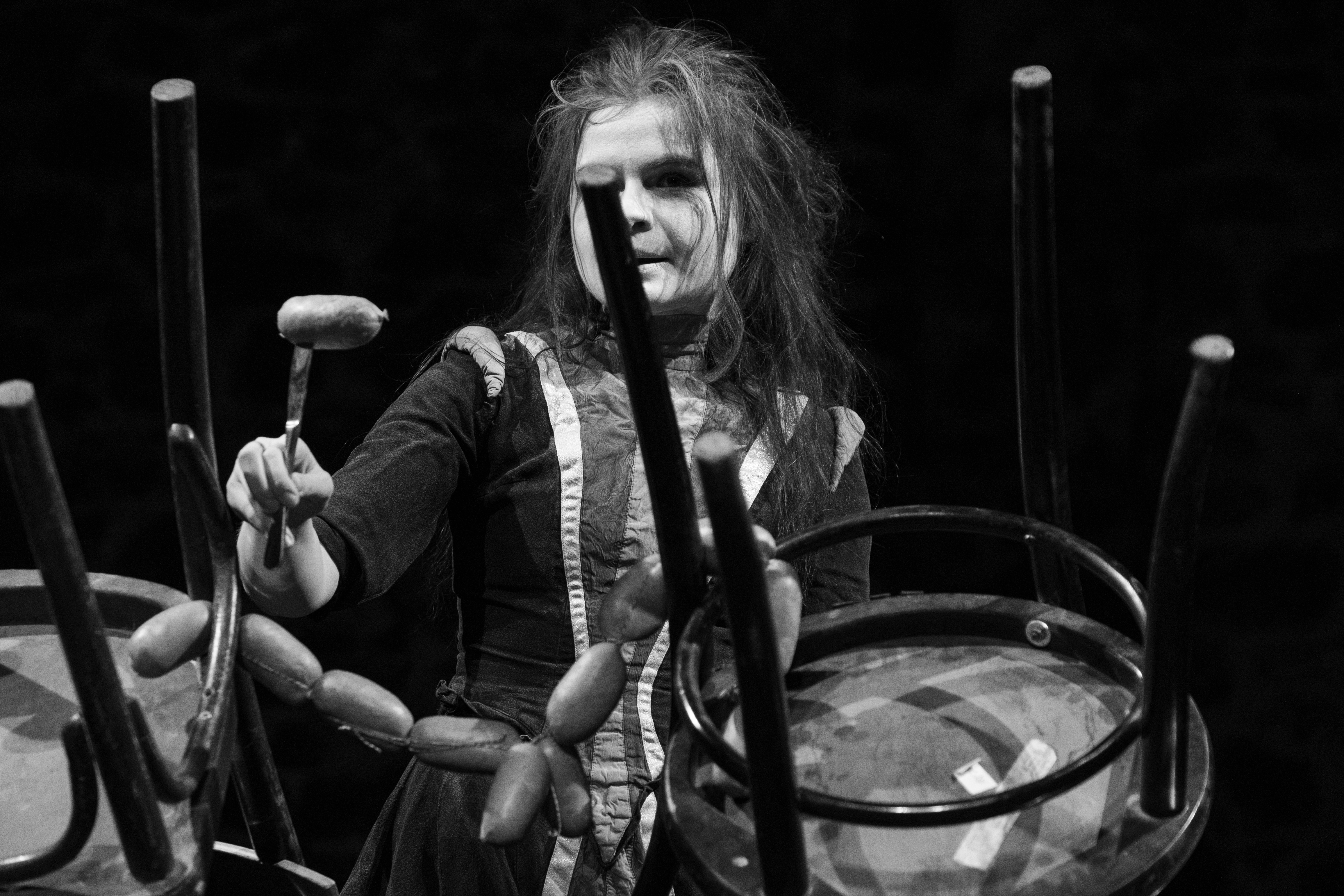
The scenography is minimal: a table, a few chairs, a black tablecloth, sausages, raspberries, and a kitchen knife. Yet these objects are far more than props. Through Solska’s voice and movement, they come alive as active elements of the performance. Sausages stand in for rulers, chairs become both Alina and Kirkor, and the tablecloth transforms into the ageing mother. The raspberries—already a motif in Słowacki—carry multiple layers of meaning: they represent the sister, an engagement ring, and the murdered body, their deep red color evoking blood with disturbing intensity.
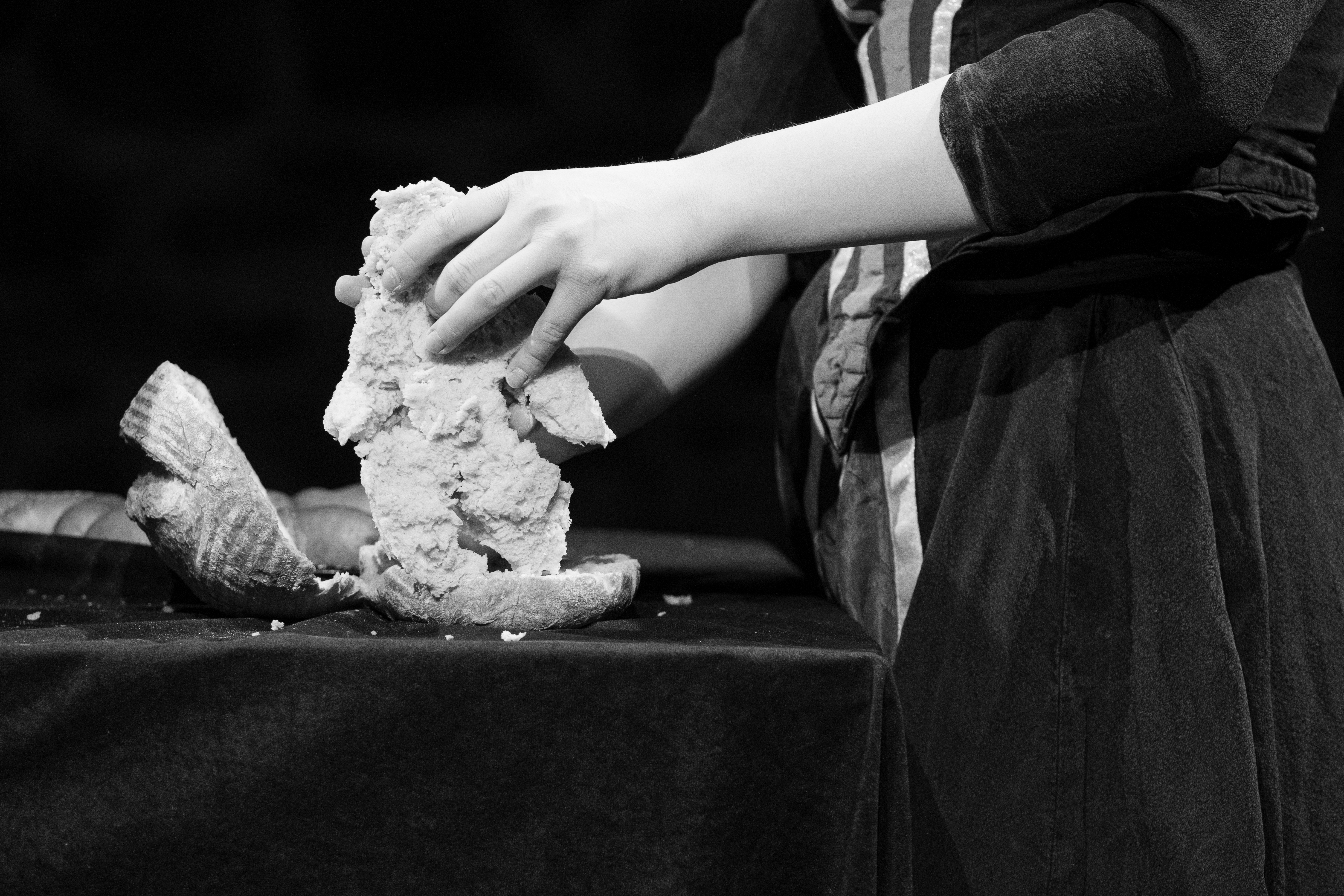
Here, character is no longer tied to a single body. Solska animates everything on stage, shifting seamlessly between roles and creating the impression of a fluid, almost shapeless entity—something like an amoeba that contains the entire fictional world within itself. This reaches its peak in the figure of Kostryn, Balladyna’s lover, represented by a loaf of bread. Treated like a puppet, it is gradually torn apart until nothing but crumbs remain. The image is strikingly brutal. Is the audience watching an object being destroyed, or a human being? And given the Eucharistic associations of bread, does this also suggest a Christ-like sacrifice?
It is also important to note that Balladyna is, in essence, a musical. Solska moves effortlessly between song and spoken word. The creators describe Balladyna as a ghost: she awakens from the afterlife and tells her story. Yet the sense of haunting lies less in this premise than in the dreamlike quality of the performance itself, its elegance combined with cruelty, gently masking something deeply grotesque. The scenes feel playful and charming, yet at the same time raw and unsettling.
The production also works on a meta-theatrical level. Balladyna becomes aware of her own fictional existence and of the fate she is determined to relive each time her story is told. Every literature class, every student who draws her as an exam topic, brings her story back to life. It creates a sense of inescapable repetition, bordering on madness.
A particularly striking moment comes when Balladyna shows a portrait of Juliusz Słowacki and sings, “Julek, why the lightning?” This serves as a beautiful culmination of the performance’s self-aware theatricality, a moment where everything it has been building toward comes into focus.
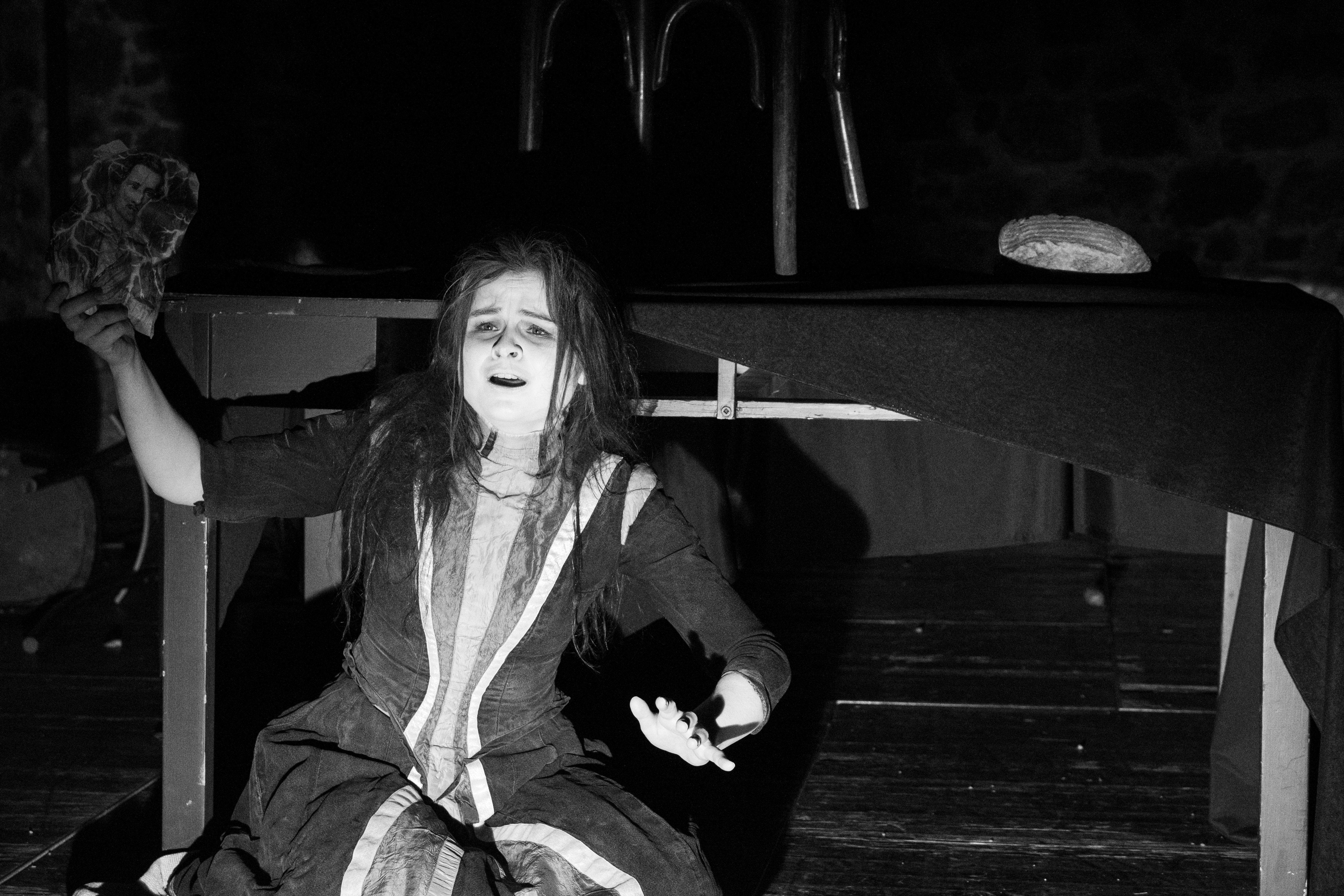
photo: Nik Machal
author: Veronika Vaňková