The Camera on Stage
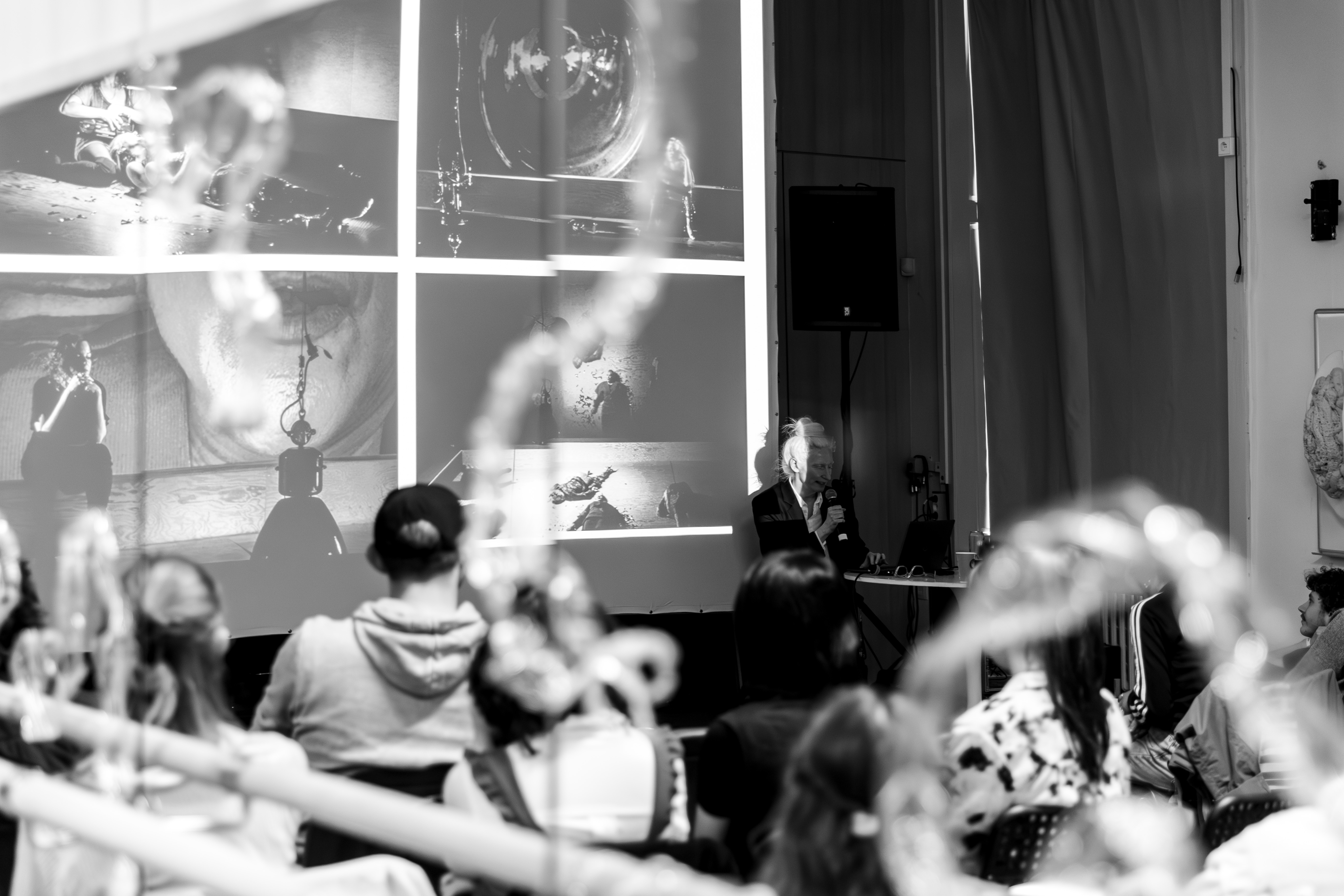
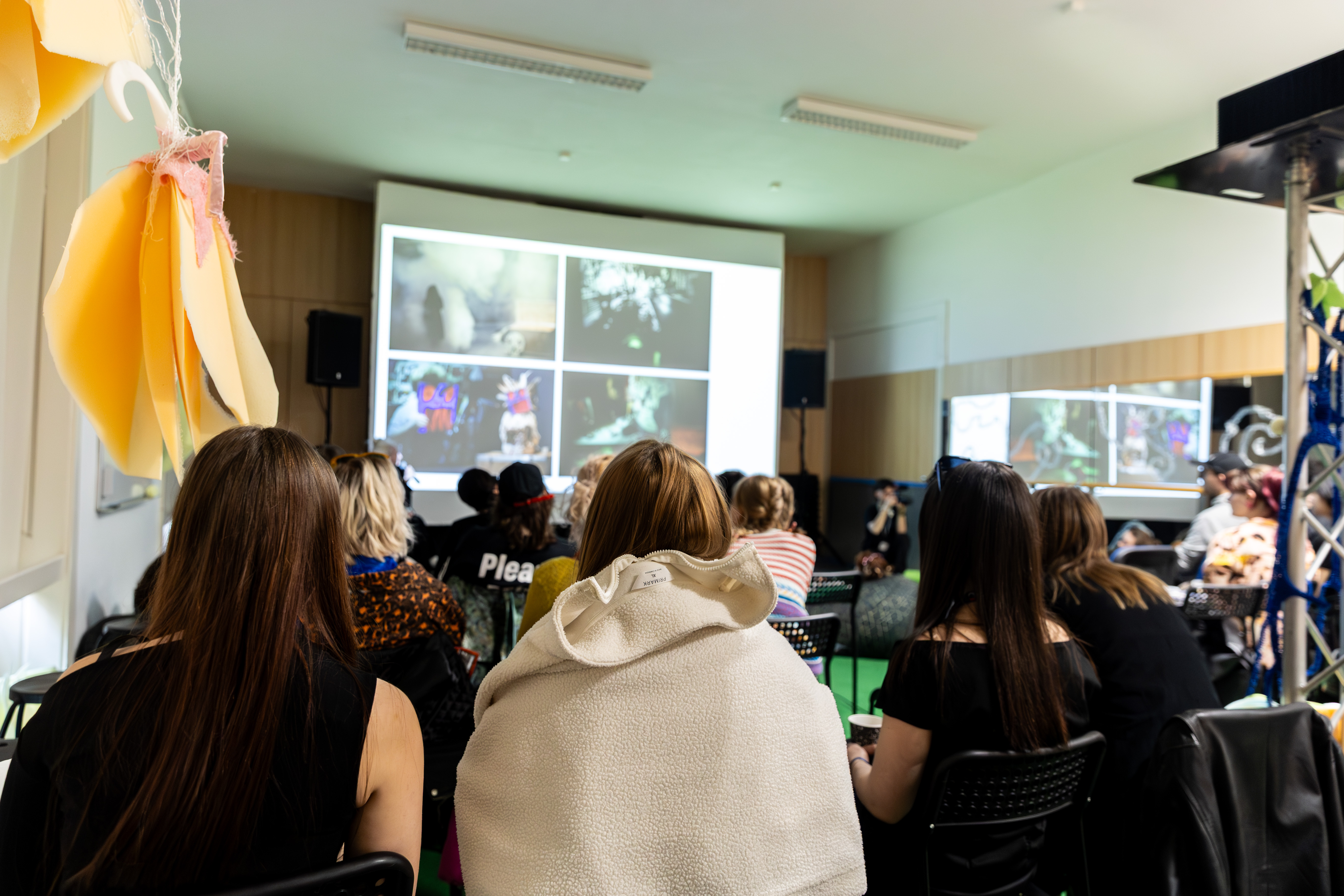
As part of the OFF program of Encounter, the festival ambassador Kamila Polívková also gave a lecture, entitled Visual Storytelling, in which she presented the principles of her work with live cinema and projections, using examples from her own productions. The lecture offered insight into a director’s way of thinking about this topic.
At the beginning, Polívková spoke about the fundamental principles of her work: she emphasises the visual aspect of productions, choosing texts mainly based on their metaphorical language and the options they offer for interpretation. She works on productions in the Czech Republic and also abroad, most often in Germany. Her long-time creative collaborator is Antonín Šilar, who introduced her to the technical aspects of live cinema.
For Polívková, live cinema can be a tool that represents a closed space which otherwise couldn't be seen on by the audience. For an example, we can look at her production Skugga Baldur. Here, through live cinema, we observe an actress locked inside a wooden box without any more complex scenographic constructions. Live cinema can also expand the overall stage space: in the same production, the camera captures the foyer, and thanks to the projection, the audience is able to perceive this space dramatically without having to leave their seats and move through the theatre building.
Polívková also emphasizes that the camera should be operated by actors rather than technicians. Filming oneself or other actors becomes another form of acting and self-expression. The projection on the screen can then represent the inner world of a character, revealing their unique perceptions. This approach is demonstrated in another of her productions, Bytost at Divadlo X10, where the main character is a psychotic cosmonaut, and live cinema offers insight into the specific form of his inner world.
This can be generalized further. As is typical for film, the camera lens can mediate almost any fictional worldview. The camera guides the viewer wherever it chooses. Even if it may not seem so at first glance, the medium of film is more manipulative: unlike theatre, it does not give the audience the freedom to decide where to direct their gaze.
This lecture led me to thoughts I have been considering for the past few years. The question is not whether live cinema belongs in theatre. Technological progress is important for its development. Everything mentioned above is without a doubt true. What I missed in the lecture, however, was a reflection on other issues connected to live cinema and other similar projections.
For example, projections provide close-ups of actors’ faces, but is that always something the audience needs? It sometimes creates a mix of theatrical and film acting. This mixture is a demanding task for actors, especially when they are observed at the same time on stage and on screen. It is practically impossible to use film acting for the camera while performing theatrically with the rest of the body for the audience. Perhaps the issue is that acting systems lag behind the development of other theatrical components. It is also possible that in the coming years, we will witness a transformation of acting. Will a hybrid form emerge, or something entirely different?
This also relates to a shift away from the essence of theatre: the interaction between actor and audience. Live cinema (and projections in general) introduceadditional variables into this relationship and disrupt it. Again, this is not necessarily a bad thing, but it needs to be named, acknowledged, and consciously worked with. If we live in a world where we constantly look at screens, do we also need screens on stage? A well-known cliché tells us that theatre should reflect its time. But is theatre not also an escape from everyday reality? Should it not help us understand our time through its own specific means?
My final point is that live cinema, like any artistic trend, faces the problem that some professional or amateur creators treat it as an end in itself. Whether we use or do not use live cinema in a production does not determine whether it will be a “good” or “bad” performance. Live cinema is not a miraculous solution. No such thing exists.
Author: Lukáš Hladík
Photo: Linda Dobrovolná